What the Research Says About How Buyers Actually Browse Real Estate Listings — and What It Means for Every Agent in the IE and SGV
Three seconds. That is how long the average buyer spends looking at the first photo of a listing before deciding whether to click through for more or keep scrolling to the next one.
Not three minutes. Not thirty seconds. Three seconds.
In those three seconds a buyer who has never visited your listing, never read the description, and never seen the address makes a judgment that determines whether your seller gets a showing request or gets scrolled past. That judgment is based almost entirely on one thing — the first photo.
Understanding how that judgment works is one of the most valuable things an agent can know about real estate marketing. Here is what the research says and what it means for every listing you take to market in the Inland Empire and San Gabriel Valley.
How Buyers Actually Browse Listings
The way buyers browse real estate listings online is not how most agents imagine it. Buyers are not carefully reading descriptions, studying floor plans, and methodically evaluating each property. They are scrolling. Fast.
Real estate platforms are designed for rapid visual consumption. Zillow, Realtor.com, and Redfin all display listings in a grid or feed format where the first photo is the only thing visible before a buyer makes the click-or-scroll decision. The listing description, the price, the bedroom count — none of that matters if the first photo does not stop the scroll.
Eye tracking research on how buyers interact with real estate listing pages shows a consistent pattern. Buyers look at the first photo for an average of 3 seconds. If the photo captures their attention they click through. If it does not they scroll to the next listing. The decision is made before any other information about the property is processed.
That means your first photo is doing more marketing work than your listing description, your open house, your social media posts, and your email campaigns combined. It is the first and often only chance your listing gets to make an impression on a buyer who has not yet decided they are interested.
What Stops the Scroll
Not all photos stop the scroll equally. Research on buyer behavior and listing performance consistently identifies the same image types as the highest-performing first photos in real estate marketing.
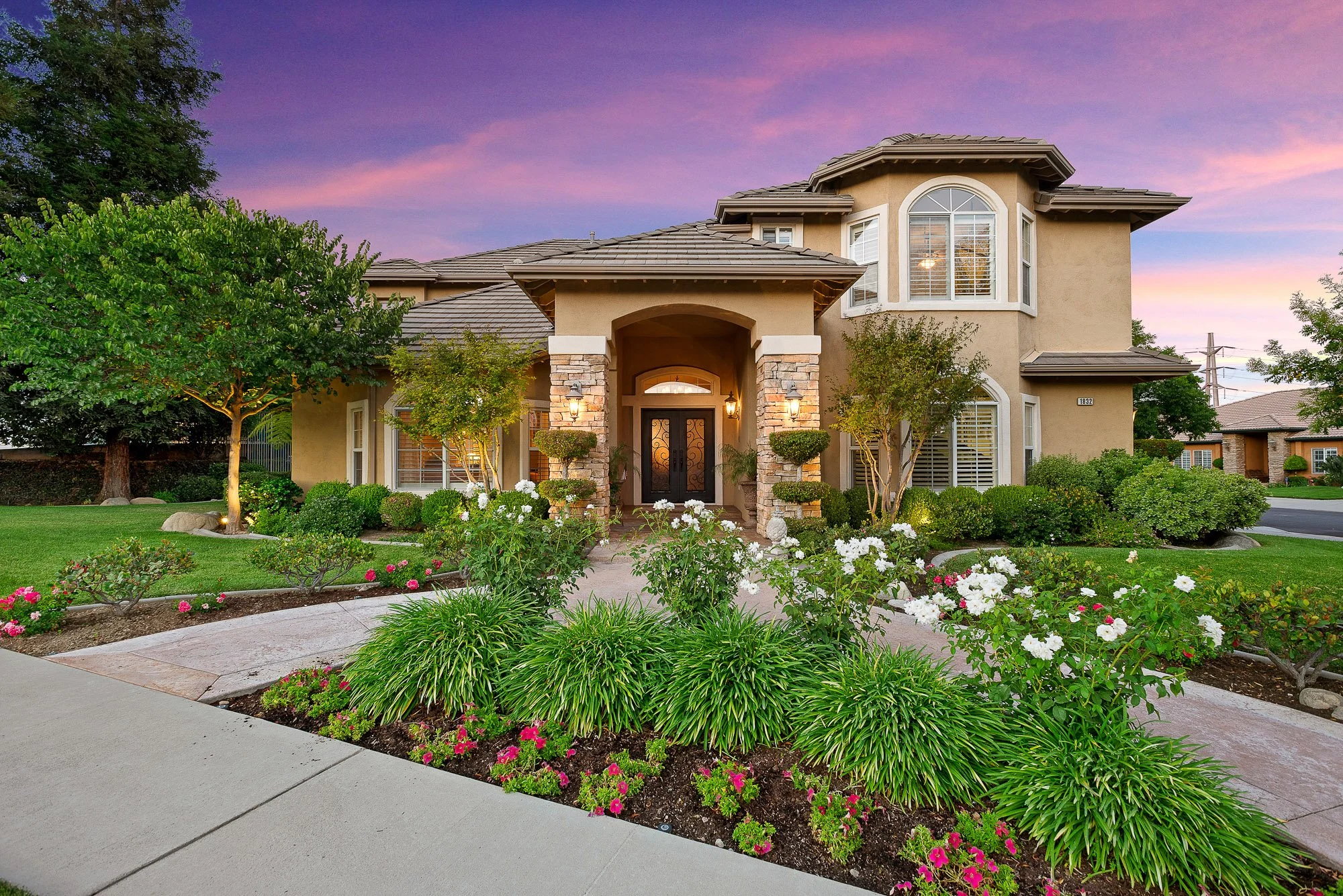
Twilight exteriors are the single most scroll-stopping image type in real estate. The warm interior glow against a deep blue sky creates an emotional response that daytime photos cannot replicate. Buyers who see a beautiful twilight exterior stop scrolling because the image triggers a feeling — warmth, home, aspiration — before any rational evaluation takes place.
Wide angle living spaces with natural light perform significantly better than dark cramped interior shots. A well-lit living room or great room that communicates space and livability stops buyers because it answers the first question every buyer has — can I see myself living here?
Drone aerials with mountain or valley views stop the scroll because they communicate something about the lifestyle and the location that no interior photo can. A buyer who sees a drone shot of a Rancho Cucamonga foothill estate with the San Gabriel Mountains behind it immediately understands something about what it would feel like to live there.
Clean modern kitchens photographed at the right angle with proper lighting consistently rank among the highest-performing listing images because the kitchen is where buyers make their most emotional connection to a home.
What does not stop the scroll: dark poorly-lit interiors, phone photos with distorted wide-angle lenses, exterior shots with overcast skies and no sky replacement, and any image where the first impression communicates neglect rather than care.
The 3 Second Judgment and What It Actually Evaluates
The 3 second judgment buyers make on your first listing photo is not a rational evaluation of the property. It is an emotional response to three questions that buyers process subconsciously and almost instantaneously.
Does this look like a home I could see myself in? The emotional response to a listing photo happens before any conscious evaluation. A well-lit, professionally composed image triggers a positive emotional response. A dark cluttered phone photo triggers a negative one. That emotional response determines whether the buyer clicks through or moves on.
Does this listing look like it is worth my time? Buyers are making judgments not just about the property but about the agent and the seller behind it. A professionally photographed listing signals that the agent and seller take this transaction seriously. A poorly photographed listing signals the opposite. Buyers who see a poorly photographed listing wonder what else about this sale is being handled carelessly.
Does this look like the caliber of home I am looking for? Buyers searching in the $600,000 to $1 million range in Diamond Bar, Glendora, and Chino Hills have a mental image of what a home at that price point should look like. Professional photography that matches that mental image gets the click. Photography that falls below it — regardless of what the actual home looks like — loses the showing before it ever had a chance.
The First Photo Is Not Always the Front Exterior
One of the most common mistakes agents make is assuming the first MLS photo must be the front exterior of the home. It does not have to be and in some cases it should not be.
The first photo should be whichever image in your media package is most likely to stop the scroll and generate a click. For many listings that is the front exterior — especially if it has been beautifully photographed at twilight or with a strong mountain backdrop. For other listings the most compelling first image might be a dramatic kitchen, a great room with stunning natural light, or a backyard pool shot that communicates the outdoor lifestyle immediately.
Think of your first photo as your listing's headline. It should make a buyer want to read the rest of the story.
What Happens After the Click
The 3 second first photo judgment determines whether a buyer clicks. What happens after the click determines whether they request a showing.
Buyers who click through to a listing are evaluating a sequence of images that should tell a complete story about the property — from the approach and exterior through the main living spaces, the kitchen, the primary suite, the secondary bedrooms, the bathrooms, and finally the outdoor spaces and any special features.
Professional real estate photography that is shot and edited as a cohesive set tells that story consistently and compellingly. Each image builds on the last, the lighting is consistent throughout, and the buyer emerges from the photo gallery with a clear sense of what it would feel like to live in the home.
Phone photography that is inconsistent in lighting, composition, and quality breaks that story. Buyers who click through to an inconsistent photo gallery lose confidence in the listing and move on.
The click is the beginning of the conversion. The complete photo gallery closes it.
The 3 Second Rule Applied to Your Listing Strategy
Understanding how buyers make the 3 second judgment should change how you approach every listing you take to market.
Choose your first photo deliberately. Do not default to the front exterior if another image in your package is more likely to stop the scroll. Look at your complete photo gallery and ask yourself — which of these images would make me want to click through if I saw it on Zillow?
Invest in twilight photography for listings where it will have the most impact. A twilight exterior as the first photo has been shown to increase click-through rates significantly compared to a standard daytime exterior. For pool homes, luxury listings, and properties with strong curb appeal in Rancho Cucamonga, West Covina, and Ontario a twilight first photo is one of the highest-ROI decisions you can make.
Use drone photography as the first image for properties where the lot, the views, or the neighborhood context is a key selling feature. An aerial first photo communicates scale and setting immediately and stops buyers who are specifically looking for those features.
Make sure your interior photography is consistent, well-lit, and wide enough to communicate space. The kitchen and primary suite are your two most important interior images. They deserve to be photographed at the highest possible standard.
The Bottom Line
Three seconds. That is your window. That is the entire span of attention your listing gets before a buyer decides whether you have earned the right to show them more.
Professional photography is how you earn that right. It is how you stop the scroll, generate the click, and give your listing the showing opportunity it deserves.
In a market like the Inland Empire and San Gabriel Valley where dozens of listings are competing for the same buyer's attention every single week the agents whose listings consistently stop the scroll are the agents who win. Not just the showing — the listing appointment that comes next.
View our Services and Pricing →
📞 Call or Text 909-234-2711 or Order Online Now